Data-driven Differential Equation Identification
Identify differential equation from trajectory data
Data-driven differential equation identification seeks to uncover the governing dynamical models underlying observed phenomena, whether traced from physical experiments or emerging from biological processes.
Our research pursues three interconnected objectives:
- Algorithm Development — designing effective, robust, and interpretable methods for recovering differential equations from noisy, sparse, or high-dimensional data.
- Identifiability Theory — establishing mathematical frameworks to characterize identifiability conditions for various differential equations.
- Uncertainty Quantification — characterizing and propagating uncertainty through the identification pipeline to produce reliable, trustworthy models.
Identification from Noisy Trajectory Data
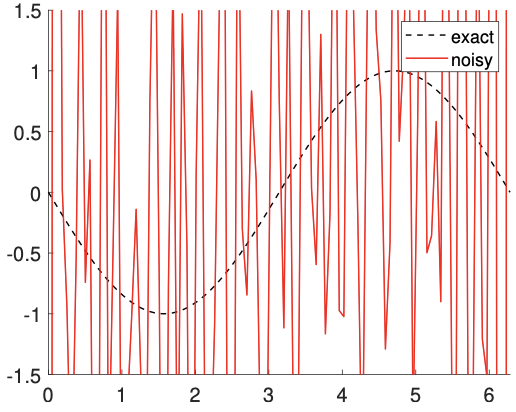
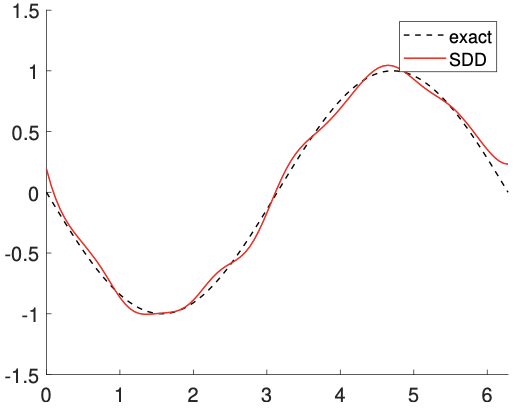
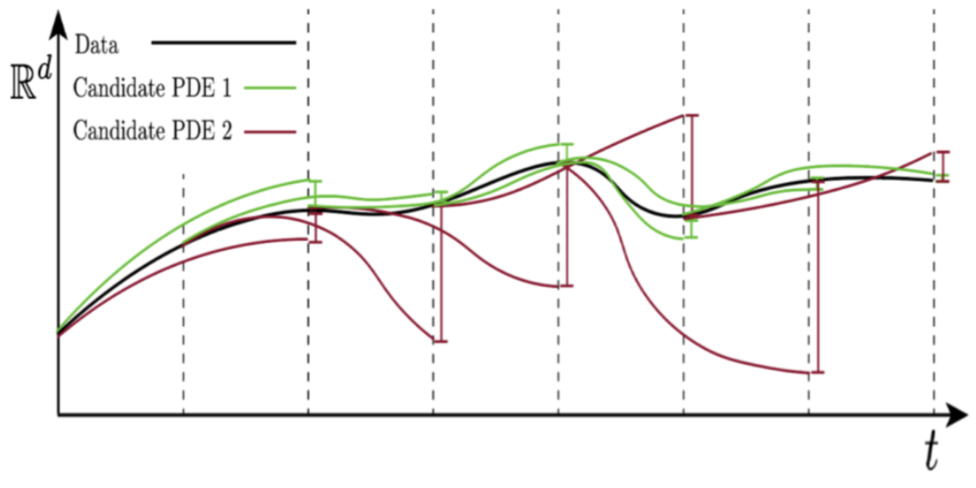
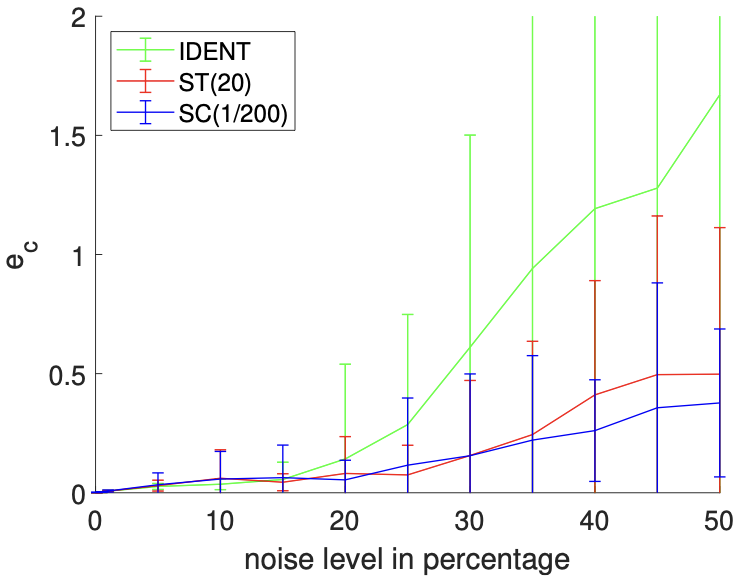
Unlike classical regression, the feature matrix consists of differential quantities estimated from single noisy trajectory data. Finite difference schemes inherently amplify noise, making accurate feature estimation and reliable model selection highly challenging. We develop robust computational techniques and rigorous model validation methods to accurately recover governing equations from noisy observations.
References
Varying Coefficient PDE Identification
Description coming soon.


References
(He et al., 2023) (He et al., 2025) (Tang et al., 2025) (He et al., 2024)
Stochastic ODE/PDE Identification
Description coming soon.

References
Two-phase PDE Identification
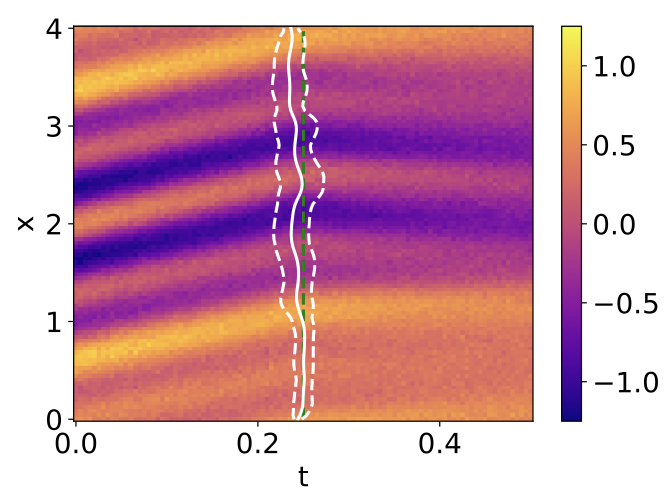
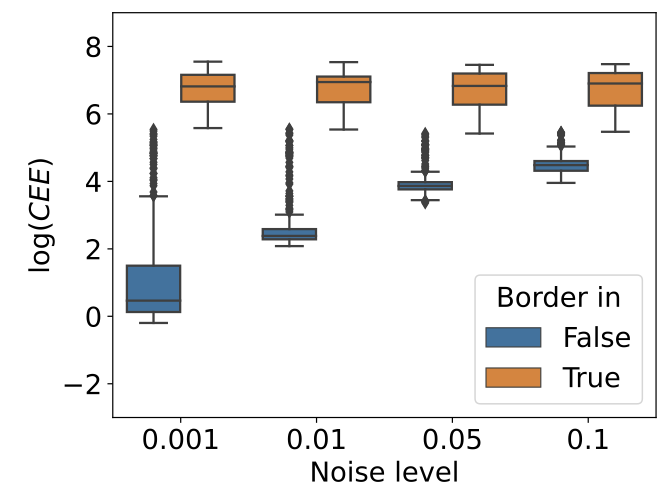
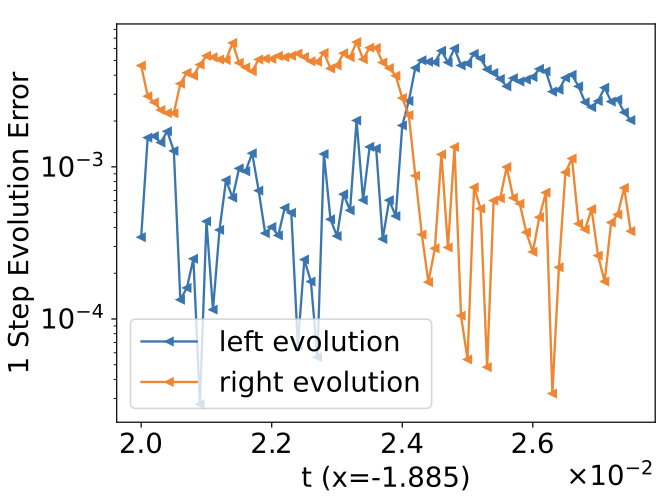
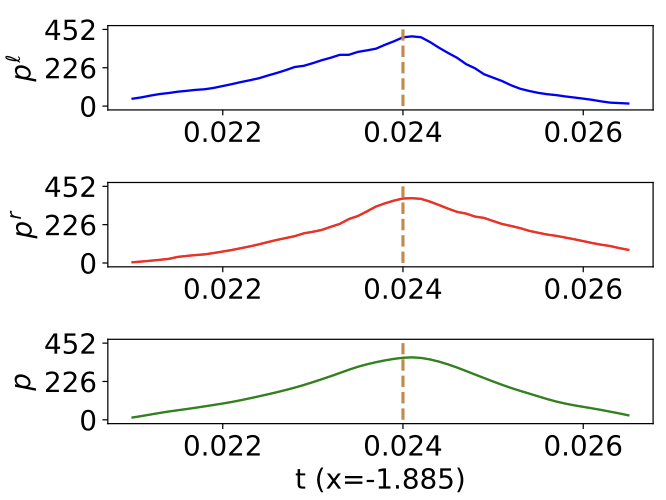
Description coming soon.
References
Identifiability Theory
A fundamental question in data-driven PDE identification is: given observed solution data, when can the underlying PDE be uniquely recovered?
- Data space characterization — for elliptic operators, all snapshots of a single trajectory stay $\varepsilon$-close to a linear space of dimension $O(|\log \varepsilon|^2)$, revealing the intrinsic ill-conditioning of single-trajectory identification
- Identifiability from two instants — for PDEs with constant coefficients, the parameters are uniquely determined from solutions at two time instants $u(x,t_1)$, $u(x,t_2)$ if the Fourier support $Q$ satisfies sharp combinatorial and geometric conditions
- Variable coefficient identifiability — for PDEs with variable coefficients, $\binom{n+d}{d}$ time instants suffice for local recovery, provided the solution contains sufficiently diverse Fourier modes
- Stability analysis — high-frequency perturbations to elliptic operators have limited impact on the solution, with explicit bounds depending on the operator order and regularity of the initial data
References
References
2026
- Phase-IDENT: Identification of Two-phase PDEs with Uncertainty QuantificationarXiv preprint arXiv:2601.11922, 2026
2025
- Group projected subspace pursuit for block sparse signal reconstruction: Convergence analysis and applicationsApplied and Computational Harmonic Analysis, 2025
- WG-IDENT: Weak group identification of PDEs with varying coefficientsJournal of Computational Physics, 2025
- Stoch-ident: New method and mathematical analysis for identifying spdes from dataarXiv preprint arXiv:2508.19177, 2025
2024
- How much can one learn a partial differential equation from its solution?Foundations of Computational Mathematics, 2024
2023
- Group projected subspace pursuit for identification of variable coefficient differential equations (GP-IDENT)Journal of Computational Physics, 2023
2022
- Robust identification of differential equations by numerical techniques from a single set of noisy observationSIAM Journal on Scientific Computing, 2022
- Asymptotic theory of-regularized pde identification from a single noisy trajectorySIAM/ASA Journal on Uncertainty Quantification, 2022